____________________________________________________________________________________________________________

Content here represents the voice of SIGNATURE SUNSETS, an informational initiative designed to broaden and brighten horizons in the funerary domain.

The material is an outgrowth of a pre-planning reference book, Pondering Leaves: Composing and Conveying Your Life Story's Epilogue, written by the author of this blog.

______________________________________________________________________________________________

Showing posts with label GREEN BURIALS. Show all posts

Wednesday, October 5, 2016

GREENSPRINGS ANNIVERSARY CELEBRATION

Journey Journal... Newfield, New York

A DECIMAL FESTIVAL... From Square One To Compound Interest

On a sun-drenched and auspicious September day, conviviality was particularly apparent at the Greensprings Natural Cemetery Preserve.  Human spirits were flourishing here amid pastures of bodily extinction.  Living souls were fully engaged in activities, fueled by the horsepower of concerted efforts.  Evidence of collegial harmony uniting a bevy of workers and participants prevailed.  One of the original founders of the cemetery was first spotted in an orange safety vest, helping a cohort direct newcomers to parking spaces.  

A celebration was underway to mark the tenth anniversary of the burial property’s founding.  The occasion brought together the visionaries who had launched this ecological initiative along with supporters and community folks interesting in learning more about a green, yet golden, opportunity.  

A tent served as central headquarters for a program of activities.  


Under its canopy were a microphone delineating a presentation corner, tables bearing light refreshments, and a beverage bar where an attendant served wine, beer, cider, and soda. 
Guests could park themselves either on folding chairs or atop ancillary bales of hay.   


Amid platters of fruits, veggies, cheese, and cupcakes, flickering candles lent ambience to the already naturally tranquil milieu. 

An a cappella group launched the program and set the tempo for a sequence of performances that followed, which included juggling, magic, and music. 


Key players in the cemetery’s development delivered information, updates, and grateful acknowledgment of particular contributors.  

People learned that two hundred and forty bodies have been buried there, with about one thousand more plots having been purchased and reserved for occupancy.  Thirty additional acres of land had recently been acquired, thereby enlarging the parcel of one hundred acres.  Use of a portion of the new territory for a pet cemetery is under consideration.  

Donations are solicited for projects and expenses of all sorts.


There are many opportunities for volunteer engagement, either as a one-time contribution or on a regular basis.  Assisting with burial ceremonies or greeting mourners are among the possibilities, in addition to serving as a representative at events such as tours and fundraisers.  

Rolling up one’s sleeves to tackle physical tasks is another option.  An old farmhouse alongside the access road has been pegged as a potential facility where visitors would be able to gather.  But for that to happen, it must be spruced up and adapted for that purpose.  Cleaning efforts could also be undertaken in the small building that serves as office headquarters.  Help with maintaining buildings and grounds might entail painting, gardening, or mowing.  And a parking lot is sorely needed, particularly at certain times of the year when navigating over grassland becomes a weather-induced challenge.  

Manpower is sought also to remove invasive species from the newly procured thirty-acre property.  Such an initiative is an ongoing mission throughout the entire cemetery terrain.  Non-native Norway spruce trees have been cut down in one of the meadows, consonant with a recommendation by an ecological advisory committee.  An annual December event, dubbed “Greenery Day,” draws a substantial number of people.  Last year two hundred individuals were on hand to topple the overgrown, non-native trees.  Folks who participate in this venture take home the tree tops to display as Charlie Brown Christmas trees.    

So Greensprings continues to be a work in progress… progress that has been remarkable during the past ten years, energized by the commitment of core leaders as well as the volunteers who have provided impressive donations of time, effort, and monetary support.   

As the program ebbed, in a bow to Buddhist tradition for wishing people well, a leader sang phrases as part of a “Loving Kindness Meditation,” invoking communal responses and contemplation of sentient words:  “May I be a source of healing, may I bring peace, may my heart be open, may I be awakened to my true nature, may you be a source of true healing, be at peace, may all beings awaken to the light of true nature…”  

Before a rendition of the well-known song, “Simple Gifts,” was sung, the burial coordinator referenced the emotional ramifications of burials at Greensprings.  Having participated in many interments there while believing that “nature is nurturing,” she has observed that being in a beautiful place helps to absorb mourners’ sadness. 

But Greensprings is for everyone, not just the mourners and the bodies of their deceased loved ones.  All seekers of outdoor resuscitation are welcome to connect with the land there by taking walks and using the grounds. 


Following the agenda of activities, guests were offered an opportunity to choose from a menu of “field trip” opportunities.  An ornithologist would lead a group through the territory to scout for bird sightings and sounds, where migratory bobolinks thrive along with meadowlarks, Henslow’s sparrows, northern harriers, and other winged flutterers.  The wife of one of the founders, Carl Leopold (whose body was buried on the grounds), is now a trustee who would give folks an overview of the cemetery’s plants.  The most colorful option entailed accompanying a gourde puppet bedecked in autumnal orange through the meadows to distribute milkweed seeds for propagation of butterfly habitats.


Dauntless guests may have opted to be led to the old, uninhabited farmhouse where the leader offered to descend into the basement for a peek at its potential.  But a number of people chose what was perhaps a less formidable and more illuminating option: an abbreviated tour of the grounds with visits to a few gravesites.  


The first stop was for a look at demonstration arenas.  Two rock-delineated gardens contained examples of native plants that families can choose to plant over graves; one has plants and the other has a small assortment of grasses.  


Nearby, the ground is dotted with examples of flat stones that would be appropriate grave markers.  


Burrowed within adjacent territory is the grave warmer (fueled by propane) that can be used if necessary to thaw the ground prior to a winter burial.  


Upon observing gravesites, individuals were given answers to their inquiries.


Plot dimensions are fifteen feet square, assuring low-density layouts and ease of maneuvering around graves with a backhoe. 

For the most part, bodies are not embalmed unless there is an extenuating circumstance.  One such situation relates to transport of a body from a state where embalming is required by law for transport to a different state.  It was noted, though, that bodies have been transferred to Greensprings by plane from California, Texas, and Georgia, but were not embalmed.

In accordance with a New York state regulation, a funeral director must certify that a body has been brought to the site of disposition.  One time a family transported their loved one’s body in a truck and the funeral director came in his own car.  

Currently, the cost for a plot to accommodate a body is $1,000., with an additional $1,000. fee for opening and closing the grave.  Small plots (290” X 90”)  can be purchased for burial of cremated remains, located in a small section of the cemetery; the cost is $350. for the space and an additional $350. to cover the fee for the burial process.    

Greensprings is characterized by heterogeneity of plot offerings.  That is, except for a field designated for Jewish burials where only Jewish people can be interred (according to the same natural principles that define green burials), there are no sections specifically for ethnic, religious, or fraternal groups.  


Across the road from the Jewish area, an expansive field labeled, “Bobolink Meadow” is where winter burials can be accommodated.  


Though New York City cemeteries are bursting at the seams, at this cemetery in the western realm of the state there's plenty of room to grow.  It was estimated that there is at least sixty percent availability of plots on land that has been surveyed, with lots of additional space in territory where surveys have not yet been conducted.    

*****
There was palpable excitement among the worker bees who had organized this afternoon affair.  It had been a success, judged by the responses and effusive affect of those who had attended the proceedings.  As a performer steered his car toward the road, he opened the window and called out to one of the organizers, acknowledging that he had enjoyed himself and he’d like to be invited back sometime.

Yes, it’s possible to enjoy oneself in a cemetery!  At this particular one, in contrast to visiting conventional burial grounds, it doesn’t entail reinforcing familiarity through observation of redundant hallmarks.  There are no headstones bearing entertaining epitaphs or paved walkways for daily strolls.  Here, unblemished by manifestations of mankind as a different type of invasive species, there’s a chance for immersion in an atmosphere that’s essentially free of human intervention.  Here, it’s possible to enjoy sensorial absorption, enabling one to get in touch with a primordial essence of beginnings and endings – the nature of natural cycles.  

Here, the presence of both the living and the dead represents a celebration of this elysian estate and all that is over, under, and around it.  On this re-appropriated parcel of land, one can’t help but feel appreciation for the impassioned spirits of those who seek to sustain nature’s bounty.   

Tuesday, October 4, 2016

GREENSPRINGS NATURAL CEMETERY PRESERVE

Journey Journal... Newfield, New York

A SANCTUARY OF LEAVES FOR LEAVING

Imagine having this dream while buried in the depths of restful sleep:

You are ambling through exhilarating hilltop meadows 
under a breathtakingly alluring blue sky 
that’s crisply peppered with cumulus puffs.  


Tall wildflowers decorate the domain, boldly bespeaking patch-like formations suggestive of islands in a sea of grass… 
perpetually waving in response to the excitement of air.    


You observe the fluttering presence of winged aviators 
as they waft through the atmosphere and chirp melodically 
within enfolding branches of established trees rooted in history.  
Might these buoyant cherubs be angels?  


It is beautiful here.  
Borne of quiescence, calm prevails.  
You conclude that you are in heaven.

Then you wake up.  Suddenly, you realize your mind had transported you to a place in the real world that is Greensprings Natural Cemetery Preserve... the first green burial property in New York State and one of the first in the country.  


Your refreshing nocturnal interlude had put you in touch with a destination opportunity that can, indeed, be grasped when heaven calls.  

*****
This parcel of land encompassing one hundred and thirty acres that welcomes the dead is situated between forested territory south of Ithaca, in Newfield, New York.  Here, the unpretentious fusion of conservation initiatives with unadulterated surroundings poses a refreshing diversion from granite-studded grounds of conventional cemeteries. 


Formerly farmland, the expanse of primarily grasslands is bordered by both Arnot Forest, a 4,000-acre bird mecca owned by Cornell University, and the Newfield State Forest that encompasses 4,000 acres of protected woodlands. 

Here, where wildlife thrives in a habitat preserved for them, humans merge with beings living and dead in this creature compound.  Reverence for nature prevails.   

Seeded In Collaboration

Aware of the burgeoning concept of green burials, two women in Corning, Jennifer Johnson and Susan Thomas, had been nurturing an aspiration for the establishment of a natural burial site.  They even conceived the name, “Greensprings,” for a property that was not yet a reality.  

Meanwhile, in Ithaca, other individuals subsequently began thinking along similar lines.  Tom Eisner, an environmentalist and Cornell University professor, was contemplating a measure to memorialize people by placing a plaque at an entrance to a nature preserve.  Mary Woodsen, an Ithaca environmentalist and science writer, had been harboring thoughts about prospecting for a natural preserve specifically designated for scattering of cremated remains.  To this end, Mary collaborated with a like-minded preservationist and founder of the Finger Lakes Land Trust, Carl Leopold.  This man had won national acclaim as a plant physiologist and conservationist and had settled in Ithaca as a Cornell faculty member.  

In 2000, these three Ithaca locals joined forces when Tom Eisner inspired Mary and Carl to help establish a site for scattering of cremated remains.  At that time, thoughts had not turned to the prospect of using a preserve for burials.  But the focus changed in 2001, after Mary took a trip to visit South Carolina’s Ramsey Creek Preserve, the first natural cemetery established in the United States.  Having witnessed a lovely green burial, she returned energized and motivated to take action.  Her cohorts, however, initially felt disinclined due to the monumental complexities of such a project, thinking it would be too difficult.

At the time, they were not aware of the two Corning trailblazers who shared such an aspiration.  But, as Mary has said, these women were “way ahead of the game.”  In 2002 someone told Mary about Jennifer and Susan, prompting a phone call and subsequent joint meeting with Tom, Carl, and a few other like-minded folks.  Everyone was eager to work together, thereby setting the wheels in motion.    

Acquisition of property for this purpose was facilitated by the largess of the town supervisor, Herb Engman, who, as an ardent ecologist, was anxious to preserve the area’s beautiful terrain. Originally, he had intended to sell his one hundred acres of undeveloped holdings. After initially adopting a strategy for Greensprings to make payments over time, he eventually donated the land in a spirit of  commitment to the project.  He is now president of the cemetery’s Board of Trustees. 

Another member of the Land Trust, Joel Rabinowitz, became involved in 2004, joining the Board as the first non-founder.  He was immersed in the development and process while also participating in burials, eventually filling the role of director a year after the cemetery opened in 2006.  

The elected Board of Trustees, currently numbering nine individuals, is complemented by a bevy of volunteers who function in many different ways.  One of the founders, Jen Johnson, is the burial coordinator – a job that entails communication with providers as well as families and sometimes participation as the ceremonial officiant.  

The project has evolved over time into a successful enterprise, attracting attention through national publications and garnering approval for certification by the Green Burial Council.   

Bedding Down With Mother Nature

In accordance with green burial principles, bodies are buried under conditions that promote decomposition and a return of organic elements to the earth.  Their intimacy with the soil is facilitated by forbiddance of obstacles, particularly, metal caskets and concrete or steel vaults as well as plastic or other synthetic items.  Only biodegradable materials are permissible.  Preservation that stunts decay is contrary to such “composting” objectives, so embalming is prohibited, except under extenuating circumstances.  In spite of the low-density, fifteen-foot-square plots, little or nothing besides a body goes in the ground.  Bodies are wrapped in cotton, silk, wool, or other natural fiber fabric within simple cardboard coffins, natural caskets, or clothed in shrouds.


Though it is difficult for a backhoe to dig a shallow grave, the question of depth for interment is an ongoing one.  The old model of “six feet under” thwarts participation by biologically active, aerobic microbes living beneath the surface where oxygen is readily available. In an effort to capture potential for their engagement, burials at Greensprings are at a depth of four and a half feet.  

Bird's Eye View

At first glance, there is little to suggest the presence of bodies underground.  Conventional headstones and markers or alternative statuary are nowhere to be seen.  Instead, there may be a natural fieldstone flush to the ground over a site, sometimes nestled in tall grasses or brush.  It can be engraved at a family’s expense.  


An assorted collection of stones is situated alongside the cemetery office.  


Sometimes family members dig up rocks from the soil here that is full of them, placing them around the perimeter of a gravesite for additional delineation.


During the month of June, the idiom, “pushing up daisies” may come to mind among astute observers who realize the tall islands of daisies amid the otherwise green landscape are actually covering graves. The oxeye daisy is apt to be the first flora to bloom over a disturbed site, representing an unintended invasive species while announcing colorful significance.   


Gravesite locations are designated and recorded in accordance with a grid system. Simple markers serve as directional guides to sites. 


Phlox Marks The Spot

Families are permitted to plant certain native perennials, grasses, and ferns over graves.  An inclusive list of allowable varieties is given to them with guidelines, and samples are grown in small demonstration gardens.  


Gravesite planting can be a therapeutic form of expression for bereaved family members who reside in the vicinity of the cemetery.  Tending to living flora above the surface affords an opportunity to render ongoing ministrations in the name of the one whose body lies below, to whom tender loving care can no longer be directly administered.
  

A large area of colorful blossoms exemplifies a mother’s committed nurturance in response to the loss of her son who had died in his early twenties. 


Trees and shrubs can be selected by families and planted by staff, but only in a memorial grove by an area designated for sequential burials, that is, where more than one plot is allocated for additional family members

Generally, graves are situated amid wild and untamed meadows, except for intervention of ongoing efforts to remove invasive species. 


Mowing is minimal, thereby averting substantial carbon emissions from equipment.  Trails are maintained through routine cutting, but around grave sites the mowing is done only once a year, in October and November.  


Home On The Range

Attending a burial here is apt to endow mourners with an experience unlike any they’ve witnessed at conventional cemeteries.  Significantly removed from a main thoroughfare, the drive along a rural road to access Greensprings sets the stage for that which is to follow.  A sense of retreat from the frenzy of familiar sights and sounds greets them upon stepping out of their cars.  Here on a hilltop surrounded by and exposed to everything natural, one becomes keenly conscious of a peaceful balm… unless the wind is having a say in the matter.  All senses are activated, instilling the essence of life in this neighborhood of the dead.  

Final proceedings are conducted in a manner more homespun than commercial.  The contained or shrouded body is placed on a rudimentary cart for the journey to its final resting place.  Dubbed, “the pallbearer’s friend” or the “spirit barge,” students in a BOCES welding class were commissioned to construct this all-terrain means of conveyance featuring durable tires.  


A commonplace farm utility vehicle, often called a mule, is utilized as a mechanical mode for transporting people through the fields.  It helps individuals for whom walking in this terrain is difficult.  Most mourners, however, walk to the burial sites.  


Upon arriving at the gravesite, the pallbearers (who are often family members) lift the casket or body and lay it on cross pieces straddling the open grave.  Ethnic, religious, or military practices may be part of variable observances that transpire.  A meaningful service of committal usually precedes the lowering of the casket by hand (rather than mechanically) using lowering straps.  A ceremonial shoveling of dirt may follow, or the entire grave can be filled in by mourners, if desired.  The grave is covered with a mound of dirt that recedes over time as the body decomposes underneath it and eventually becomes flush with the ground.  Evergreen boughs are placed over and around the grave.  

Individuals in attendance become absorbed in the proceedings and the aura of it all.  "We've seen people come to a burial in pain and leave with joy," says Mary Woodsen.  "It can be transformative for people to lower their beloved dead into the grave themselves.  It's so different than the conventional approach, where you walk away after a committal service and a mechanical lowering device does the committal instead."  

Anyone who attends a natural burial may experience attitudinal remodeling.  Witnessing the basal return of a body to earthly elements can prompt a mutation of one’s death perception… that, in this context, the end of life begets new beginnings.  A green burial awakens the senses, causing people to take note of its logic while tapping into their internal reservoirs of feelings and spurring pervasive absorption that won’t be forgotten.

One woman documented her experience with these words:  “I went to a burial at Greensprings in the winter, with snow on the ground. There was a horse there to pull the body on a sleigh. The horse had black and silver livery, and it was so cold you could see the breath from the horse. The person who had died was in a shroud—you could see the shape of her body and there was greenery on the body for simple, natural decoration. People participated in filling the grave. There were a lot of tears, and there was something about that environment that seemed to welcome their heartbreak; the earth welcomed the body. They weren't putting the body in a lead-lined box and keeping the body from the earth. It was raw, painful, and beautiful. I wonder if the stark simplicity of such burials allows us to more deeply take in what has happened — and thus provides for some measure of healing.”  (Saoirse McClory, “Greensprings Completes a Natural Life, by Jayalalita for Green Leaf, GreenStar Natural Foods Market, originally published May 5, 2013)

*****
Perhaps the green burial movement in this country has ignited a newfound appreciation for the utility of human substance within an amazing sphere of creation.  Perhaps people are progressively welcoming opportunities for riveting connections impelled by expressive proceedings of death.  Increasingly, interest is being stoked by efforts like those of the Greensprings trailblazers who broke ground and unearthed an opportunity for ecologically conscientious bodily disposition.  Long live their spirit of devotion to the natural life cycle and organic renewal!  


_________________________________________________________________________

Thursday, August 20, 2015

RAMSEY CREEK NATURAL BURIAL PRESERVE

Journey Journal... Westminster, South Carolina

THE LIFE of DEATH


Either the name of the site, Ramsey Creek, or the name of the company, Memorial Ecosystems, is apt to be recognized as an icon by providers in the death care industry.  The enterprise is widely lauded as the original prototype for conservation burial grounds in the United States and its footprint has made its way also to other parts of the world.  Established in 1998, it epitomizes the concept of utilizing untainted landscapes of acreage for bodily disposition in order to sustain substantial territory as a haven of ongoing, natural life.  Land protection and restoration dictate operations. It was the first of such projects to be certified by the Green Burial Council – the first so-called “green cemetery.”  The fledging expanse of thirty-eight acres has been augmented over time, now amounting to seventy-six protected acres and exemplifying the conservational thrust of such undertakings.  Through collaboration and an agreement with a non-profit land trust program, Upstate Forever, the site will remain forever wild. 


Designation of such burial grounds as protected land – based on long-term covenants, deed restrictions, and state laws banning development of cemetery properties – assures that there will be no future intrusion by bulldozers razing trees and leveling the grounds for housing or commercial establishments.  Status as a burial site permits this manner of exclusion, yet burials are secondary to the overall objective of earthly preservation.  Compared to high-density interments at accustomed cemeteries, where an underground occupant has neighbors encroaching upon one’s confining patch of a plot, bodies embedded in natural preserves are more apt to dot the turf sporadically, with plenty of “room to breathe.”

Proceeds from the sale of plots breathe life into funds for restoration and acquisition of land.  Endowment monies are utilized for maintenance measures such as attending to trails and other public spaces, maintaining equipment, thwarting growth of invasive species, and acquiring tools, like devices for identification of grave sites via mapping software (GPS and GIS). 

At Ramsey Creek Preserve, people are offered opportunities to make memorial donations for building renovations, stained glass windows in the chapel, benches, and plantings of trees, shrubs, and wildflowers.  Burial of cremated remains is an option, based on the reality of an escalating cremation rate and the prudence of using funds from such plot purchases to advance the cause of land preservation.  Pet burials also are acceptable.  

The cemetery is located between the southern Appalachian Mountains and the Piedmont sector in the western realm of South Carolina.  Nestled among countrysides evocative of summer camp settings, the area bespeaks a stark contrast to the city of Atlanta that’s little more than a hundred miles to the south of it.  State parks within range embellish the vicinity.

Upon escaping the tumult of the region’s interstate highway, the fifteen-mile drive into Westminster offers visual refreshment vitalized by sweeping panoramas of grass and groves of trees untarnished by industrialism.  A ride through the main street reinforces an impression of distinctive singularity, where businesses are solo operations unchallenged by competitive forces.  There is one funeral home in town and one doctor, Billy Campbell, who with his wife, Kimberley, happens to have been the prime mover and co-founder of the burial grounds.  He had grown up in the Westminster environs and returned to serve as a physician after completing his training at the Medical University of South Carolina.  

Undergraduate studies as an ecology student at Emory University laid the foundation for this trailblazer’s eventual initiative.  Academic absorption in medical school concomitantly accompanied by reading of literature about death put flesh on the idea that was already taking root in cognitive chambers.  As a youngster, sleepovers with the local funeral home owner’s son in the upstairs family quarters could possibly have bolstered a proclivity for this mission as well; maybe sleeping on satin pillows ordinarily reserved for casket interiors, but extracted from downstairs inventory, had contributed to his comfort with matters of death.  

Interest in reinvigorating the age-old concept of natural burial purportedly was triggered by an awareness of an eighth-grade teacher’s wish to be buried in a burlap bag with a tree planted over it.  Later, the impetus for implementation of such an endeavor was prompted especially by a medical anthropology article about spirit forests in New Guinea, embedding the seed of inspiration for a means of land preservation in Billy’s mind.  In partnership with one another, Billy and his wife, Kimberley, who had hailed from the United Kingdom, were able to cultivate the idea and bring it to fruition. 

Given their wealth of experience, these pioneers have been tapped as expert consultants by others seeking to launch such projects elsewhere.  Besides attending to their own venture in Westminster, they travel and collaborate to confer knowledge and advice.  Their principles of operation and guidance have contributed a signature stamp to other sites that have been developed. 

Considering the extent of this establishment’s prominence, it may be somewhat surprising that access to the premises is rather inconspicuous.  Visitors in the know can ascertain they have arrived at the spot upon seeing a couple of dangling orange ribbons signifying that it is a "no pesticide spray zone." There is nothing in the way of fanfare at the threshold of the bucolic property. The absence of a sign alerting drivers to the road leading to its location and the pedestrian entrance belie its archetypal status so familiar to anyone who has explored funerary territory. 


But upon contemplation of this contradiction, one recognizes the parallels between appearance and principles.  Mainstream cemeteries commonly engorged with closely situated headstones or fields of plastic blossoms hint at manufactured chaos below their grounds, suggesting conspicuous consumption in a material world.  Here, the absence of prominent signage or funerary furnishings reflects an attitude of simplicity in unadulterated surroundings.    

Administrative functions take place in town at an office on Main Street.  A house by the entrance to the preserve that's currently occupied by a relative is pegged to serve someday as a steward's quarters and a site for lodging of visiting naturalists.  


Across from a portable toilet stationed by corner hedges, a rustic barn with an embedded porch is available so people can gather to converse, perhaps before or after a graveside service… or for other unrelated purposes.  Several wedding receptions have taken place here.  


A room inside the building houses a small display of urns crafted by a local woodworker in addition to a single basket coffin.


Though most of the land is forested, there are open meadows with tall grasses covering sites where individuals’ bodies have been buried.  Growth is unimpeded by mechanical intervention.  Periodically, controlled burns are employed as the preferred technique for restricting intrusion by foreign species of vegetation and stimulating germination of native varieties upon release of nutrients into the ground.  


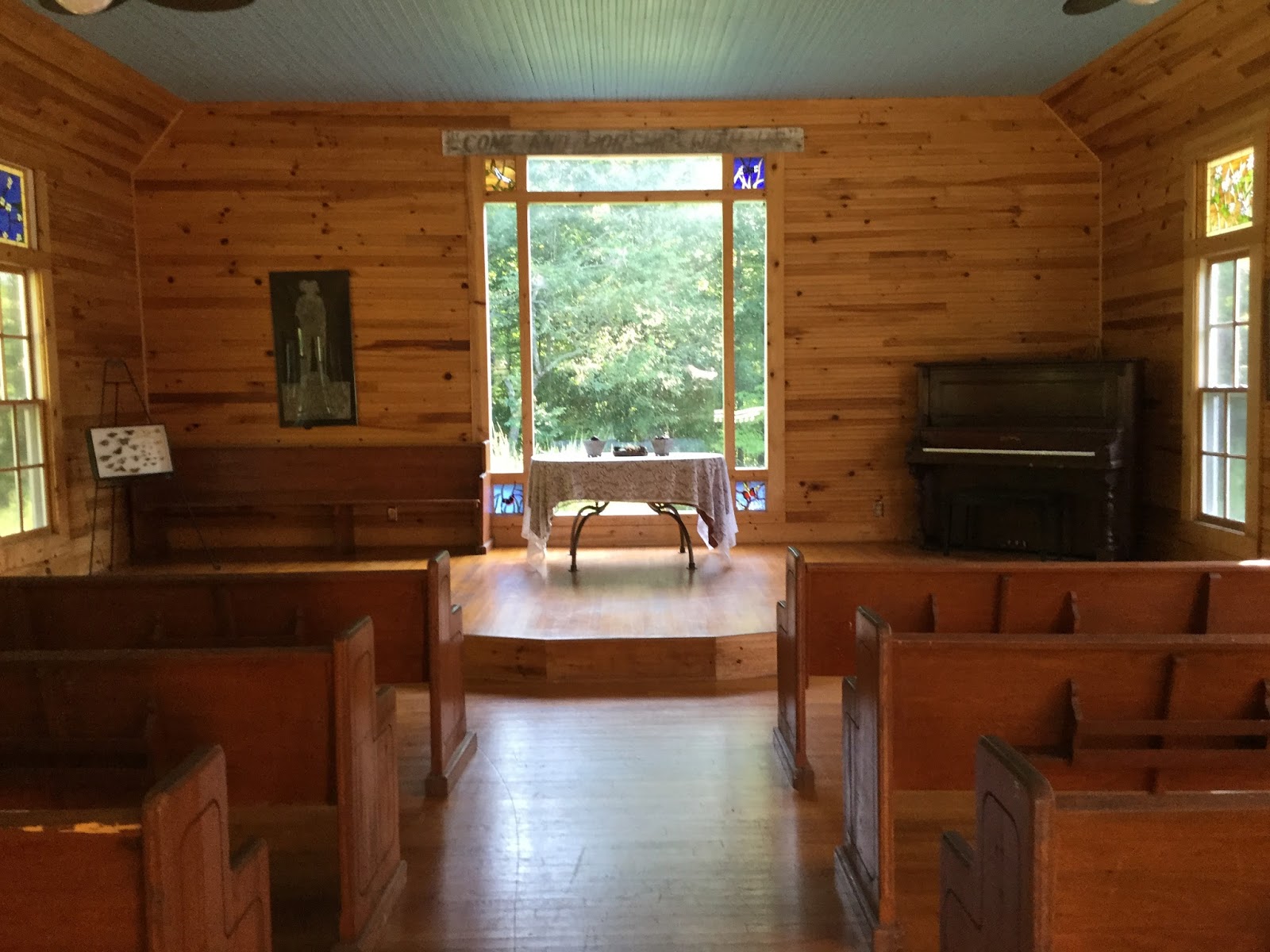
Often when Ramsey Creek is envisioned, it is the all-faith chapel that comes to mind because of its frequent appearance on websites.  Sight of the representative building at the end of a dirt road prompts a sense of familiarity.  


An original plan to construct a chapel was dismissed upon learning of an abandoned country church within range of the grounds.  Subsequently, it was relocated to a clearing adjacent to the wooded terrain on the property.  


The repurposed building has been beautifully restored, with its gleaming wood interior reflecting the essence of nature, lending warmth and comfort for bereaved guests who occupy it for services.  


Decorative windows that have been contributed as memorial gifts Infuse the arena with colors and designs. 


Dirt trails define pathways for walkers, casket-bearing wagons, and the three golf carts that comprise essential equipment.  


Along the way, the integrity of the land is dotted occasionally with evidence of burials at particular sites… a mound of dirt punctuated by foliage, possibly suggestive of a recently occupied grave…


… a stone marker that’s native to the area, bearing engraved names and dates…


… or sometimes a primitive, handmade stone or wooden bench.  These rough-hewn seats are popular additions, but availability is limited.  


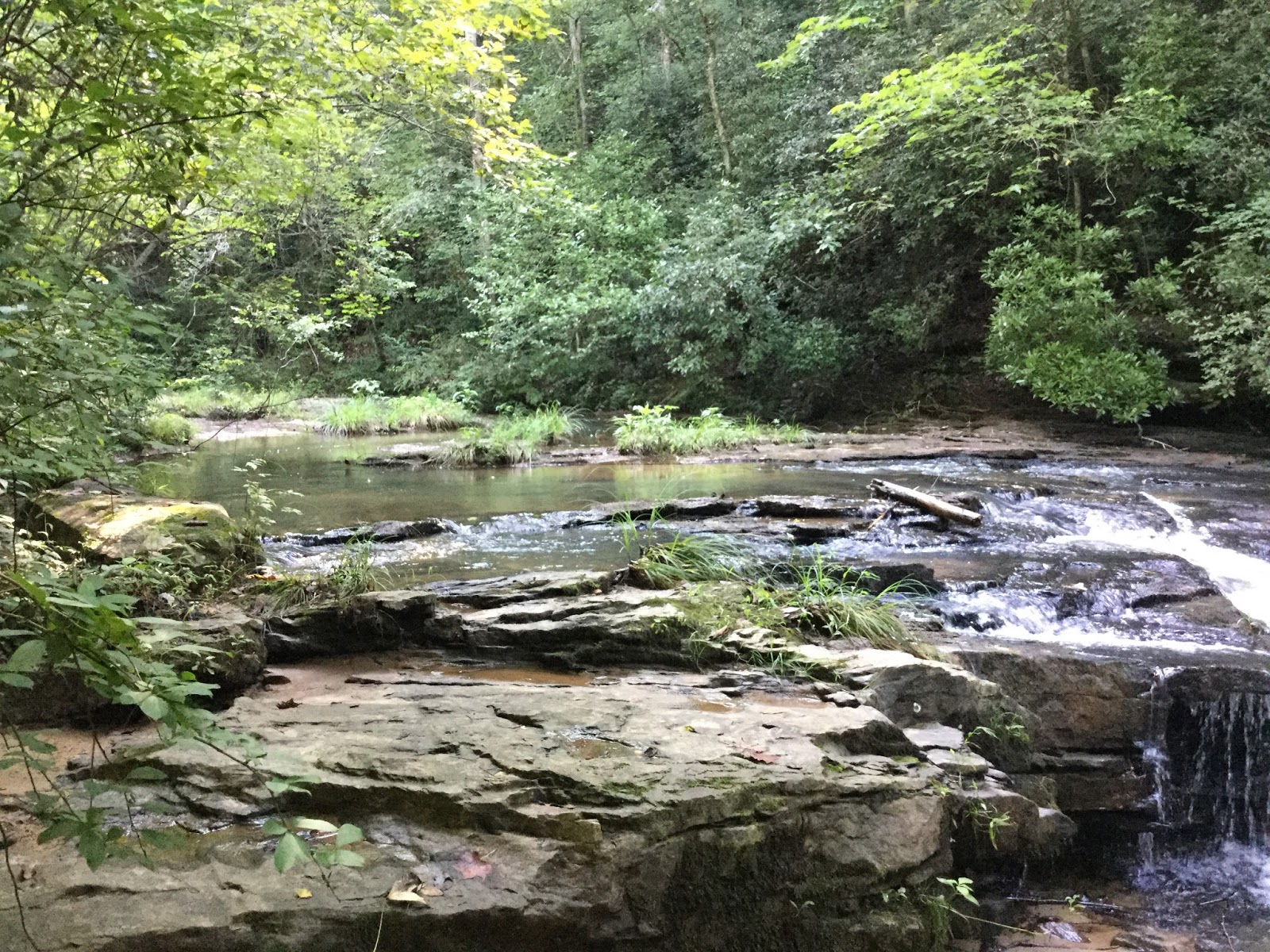
As a prominent feature of this preserve that bears its name, the narrow, curving Ramsey Creek awash with fish winds along the eastern border of it in resounding accentuation.  


The flow of water courses over five rock shoals in its path, creating a sensorial aura of tranquility.  


It’s no surprise that folks tend to prefer burial sites closest to the water, which cost more than ones in other locations.  

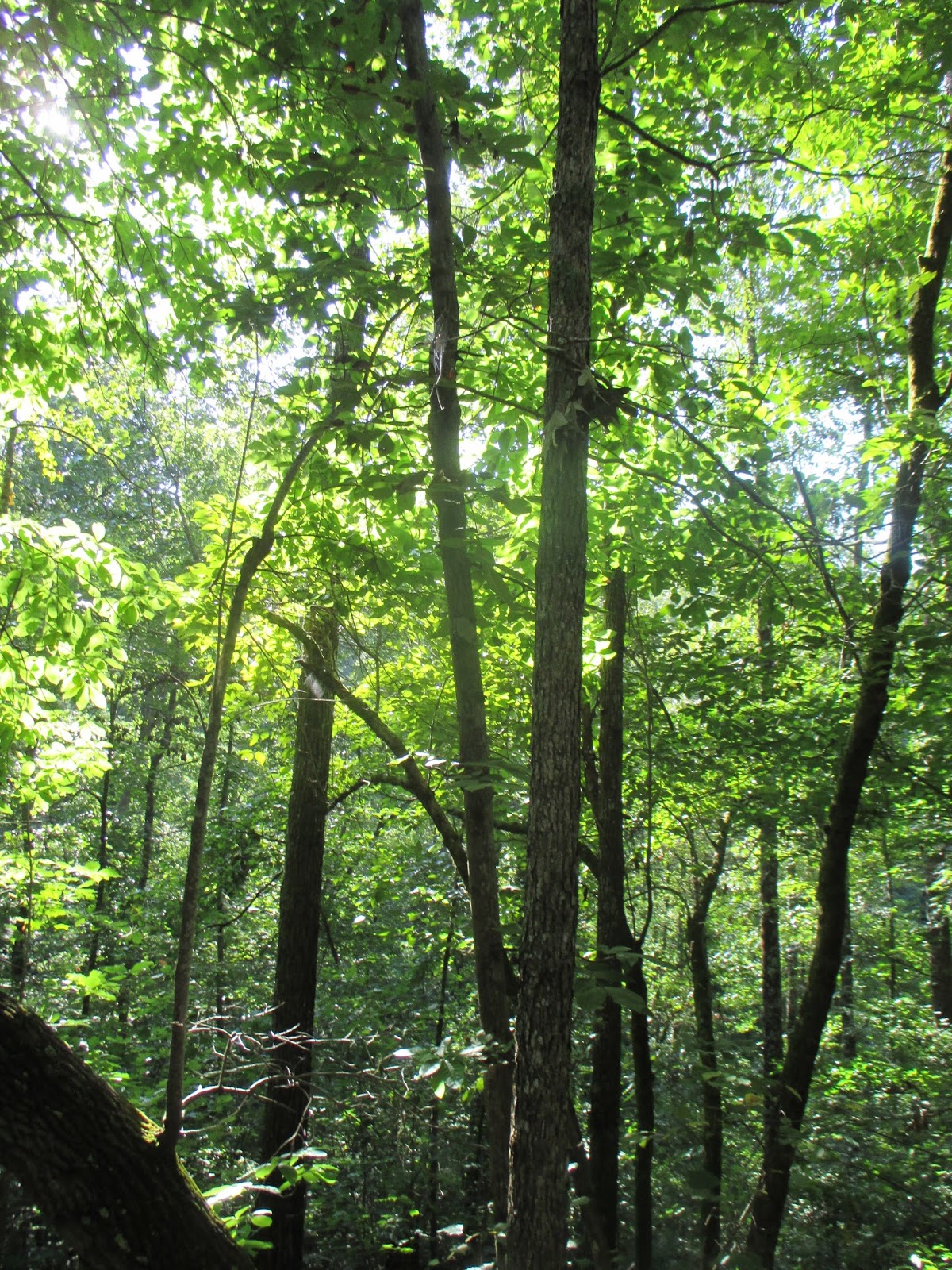
But signature manifestations of a natural environment prevail in other locations as well.  This land with its underground repository for the dead is sumptuously blanketed with life.  Under a cathedral of tall trees, it is a sanctuary for pastoral communion by anyone who meanders through it.  


Innumerable species of plants, trees, shrubs, grasses, ferns, vines, herbs, and sedges have been observed and noted on Internet-accessible lists delineating their presence.  Listings swell with new additions after purposeful explorations by visiting naturalists.  Native prairies and savannas, the most endangered southern grasslands, are growing here.  Certain rare species of vegetation, including federally designated endangered ones, have been propagated over grave sites.  

Animals such as deer, wild turkey, dogs, coyotes, and an occasional black bear share tenancy.  Here, where the dead nourish and sustain the living, this place is undoubtedly an environmentalist's paradise… perhaps a version of heaven.  However, one need not be dead to occupy its spaces.  Hiking, bird watching, and special events – even weddings – are encouraged.   

Based on the primordial principle of dust to dust, the human dead here nourish other life forms.  Bodies robed in shrouds or reposing in non-toxic, biodegradable caskets degrade naturally, free of chemical infiltrations or any type of manufactured containment that won’t break down readily.  As decomposition progresses, each burial contributes to the efflorescent restoration of a particular spot, with nutrient deposits effecting the cycle of life, facilitating ongoing rebirth in continuously changing forms.  

Interments in this setting are truly personalized rather than standardized.  A bulldozer is nowhere on the premises.  The groundbreaking founder often breaks the ground himself, removes the dirt, and prepares the sites.  Families have not been keen on digging the grave themselves, opting instead to fill it in with shovels of dirt once a body or casket has been lowered into it.  Kimberley provides flowers for the grave site. 

This cemetery that is teeming with life most likely evokes treasured memories in the minds of those who have experienced burial proceedings within it.  Meaningful measures executed by family members and friends are accented by gestures thoughtfully delivered by Billy and Kimberley.  

Although individuals from any part of the country may be buried here, sometimes for this cemetery’s proprietors there is a penetrating element of poignancy when local townspeople are the folks interred.  In a small community generating close connections, the sorrow of deaths may be felt from an especially intimate perspective.  Since Dr. Campbell is the only local physician, in some instances he has been the person who has diagnosed a terminal illness, informed the victim and the family, possibly followed the person in hospice mode, and subsequently managed the burial.  In any case, regardless of a decedent’s point of origin, these dynamic providers apparently are moored to a steady diet of committed attentiveness and personal touches.  

Guests at the forty to sixty funeral affairs per year often assume roles as participants in many different ways, enabling them to address their grief through active involvement.  Each event is apt to be managed according to individualized measures reflecting characteristics or wishes of the person who died or according to expressive variations of therapeutic value for close companions.  Lives can be enriched when undertakings prompted by deaths are relevant and inspiring.   

A quoted notation on the Memorial Ecosystems website encapsulates the essence of someone’s experience:

“… the first time we came out here, we knew it was right for Chris.  It’s beautiful and peaceful.  It’s full of life, not death."  "When he died, they buried Chris in a coffin his father had made, wrapped in quilts sewn by his great-grandmothers.  His dog Briar was at the graveside, along with 70 friends and family members.”

A conclusive presumption is that burials in this milieu are special.  Amid the sounds of a rushing stream, rustling trees, and flitting birds, the proverbial “resting in peace” feels attainable.  But it is especially possible for those who are mourning their losses… those who are there briefly for committal activities or those who return periodically to visit grave sites while absorbing the atmosphere… or for anyone who seeks to be soothed by nature’s balm.

The notoriety that has come from the efforts of Billy and Kimberley Campbell has been a boon for the birds and bees and flowers and trees, both near and far.  These environmentalists realized the value of reviving an outmoded practice in conjunction with a strategy to capitalize on it as a conservation measure.  In recognizing and actualizing opportunities of death, they nurture life.  Because of them, an idea has been hatched and a variation in contemporary death management has taken root in ever-expanding locations around the country and the world.  In concert with Mother Nature, they have developed a lasting legacy... treasures of ecological significance that will be appreciated through the ages. 


_________________________________________________________________________